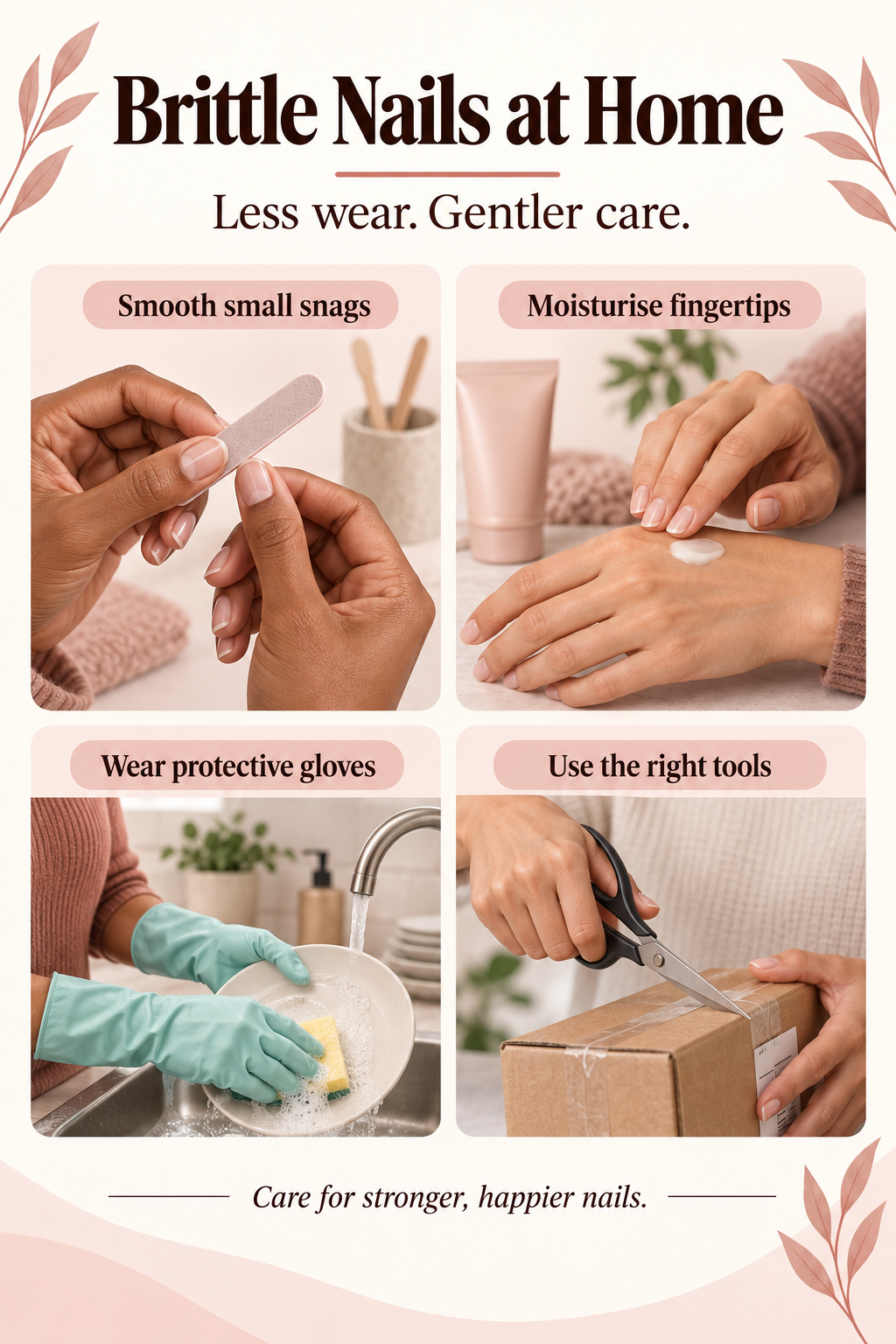
Brittle Nails at Home: Reduce the Everyday Wear and Tear
Brittle nails can turn ordinary tasks into a cycle of snags, peeling and uneven edges. Before buying another treatment, look at the everyday wear your nails receive. Frequent wet work, picking and forceful manicure removal may be making an already fragile nail harder to maintain.
Quick answer: Keep brittle nails at a manageable length, moisturise regularly and reduce the tasks or treatments that repeatedly damage them. Avoid kitchen bleaching recipes and aggressive buffing. Persistent or unexplained changes need an assessment.
Look for a pattern before changing everything
Think about when the splitting became noticeable. Did it follow a gel removal, a new cleaning routine or a period of more frequent hand washing? Are all the nails affected, or does one finger repeatedly catch on something at work?
Write down two or three likely sources of wear. This is not a diagnosis, but it gives you a more useful starting point than buying several products at once. Keep a photograph for comparison, especially if you struggle to remember whether the appearance has changed.
Make a small repair kit
A fine nail file and a comfortable hand cream can cover much of a simple routine. Keep them somewhere convenient so a small snag does not turn into an afternoon of picking. If a file feels very coarse, use a gentler one with light pressure.
- Shorten a catching free edge carefully.
- Leave the attached nail surface alone rather than thinning it with a buffer.
- Use a proper tool for opening packaging or scraping.
- Take off rings for tasks where they trap moisture or irritate the surrounding skin.
A repair kit is for minor grooming. Do not glue over a painful, lifting or inflamed nail to make it look tidy. If ordinary filing hurts, stop and ask for advice.
Protect hands during wet work
The NHS recommends protective gloves and regular hand cream for common nail problems. Choose gloves suitable for the task, keep their interiors dry and give your hands a break if they become sweaty. Dry carefully after washing, then apply cream over the fingertips as well as the palms.
Make protection part of the task itself: store gloves beside the washing-up liquid rather than in another room. For work that requires frequent washing, choose a routine compatible with workplace hygiene rules. Do not skip necessary hand hygiene to protect a manicure.
Review your polish and removal habits
Notice what happens after each manicure. If a particular treatment consistently leaves your nails sore, thin or peeling, pause it. Avoid pulling off gel, scraping stubborn polish with a metal tool or filing the surface until every mark disappears.
Ordinary polish is optional. A neat, bare nail can be easier to monitor while you simplify your routine. If you choose polish, follow the remover’s instructions and moisturise afterwards. Our simple manicure guide keeps preparation gentle.
Skip the pantry treatment experiment
Lemon, strong peroxide mixtures and abrasive scrubs do not address every cause of fragile nails. A tingling or stinging sensation is not evidence that a remedy is working. Avoid alternating several treatments when the skin is already irritated; it makes the source of a reaction harder to identify.
For long-term nail care, see our healthy nail growth routine. The goal is fewer episodes of damage, not a dramatic overnight change.
Frequently asked questions
Can brittle nails improve immediately?
You may be able to smooth a snag straight away, but damaged nail has to grow out. Judge the routine by comfort and fewer new breaks, not an instant change in the entire nail plate.
Do I need a hardener?
Not necessarily. Products differ, and a product that stings or makes nails feel more brittle is not helpful for you. If basic care is not enough, ask a dermatologist which treatment fits the cause rather than layering several hardeners.
When should I stop treating this as a cosmetic issue?
Seek advice if changes persist, affect nail shape or colour without an explanation, or involve pain, swelling or separation. Mention medicines, recent illness and nail treatments at the appointment; these details can help guide the assessment.
Editorial update: 21 October 2026.