A Beginner-Friendly Arm Workout for Strength and Confidence
A beginner arm workout should leave you feeling capable, not defeated. A wall and a pair of light weights are enough to practise useful upper-body movements. Start with a manageable session, learn the technique and build the challenge as the exercises become easier.
Quick answer: Begin with wall press-ups and controlled biceps curls, using a small number of comfortable repetitions. Rest between sets and leave recovery time between sessions. Arm exercises build strength; they cannot selectively remove fat from the arms.
Set up a comfortable training space
Choose a clear floor area, a solid wall and shoes that will not slip. For curls, use light dumbbells or two evenly filled, tightly closed water bottles that you can grip securely. Keep pets, bags and loose rugs away from the space where you will move.
Warm up with a few minutes of easy walking or marching and relaxed shoulder movements. You should be able to breathe normally. If you have an injury, a condition that affects exercise or uncertainty about what is appropriate, ask a qualified professional for an individual starting point.
Exercise one: wall press-up
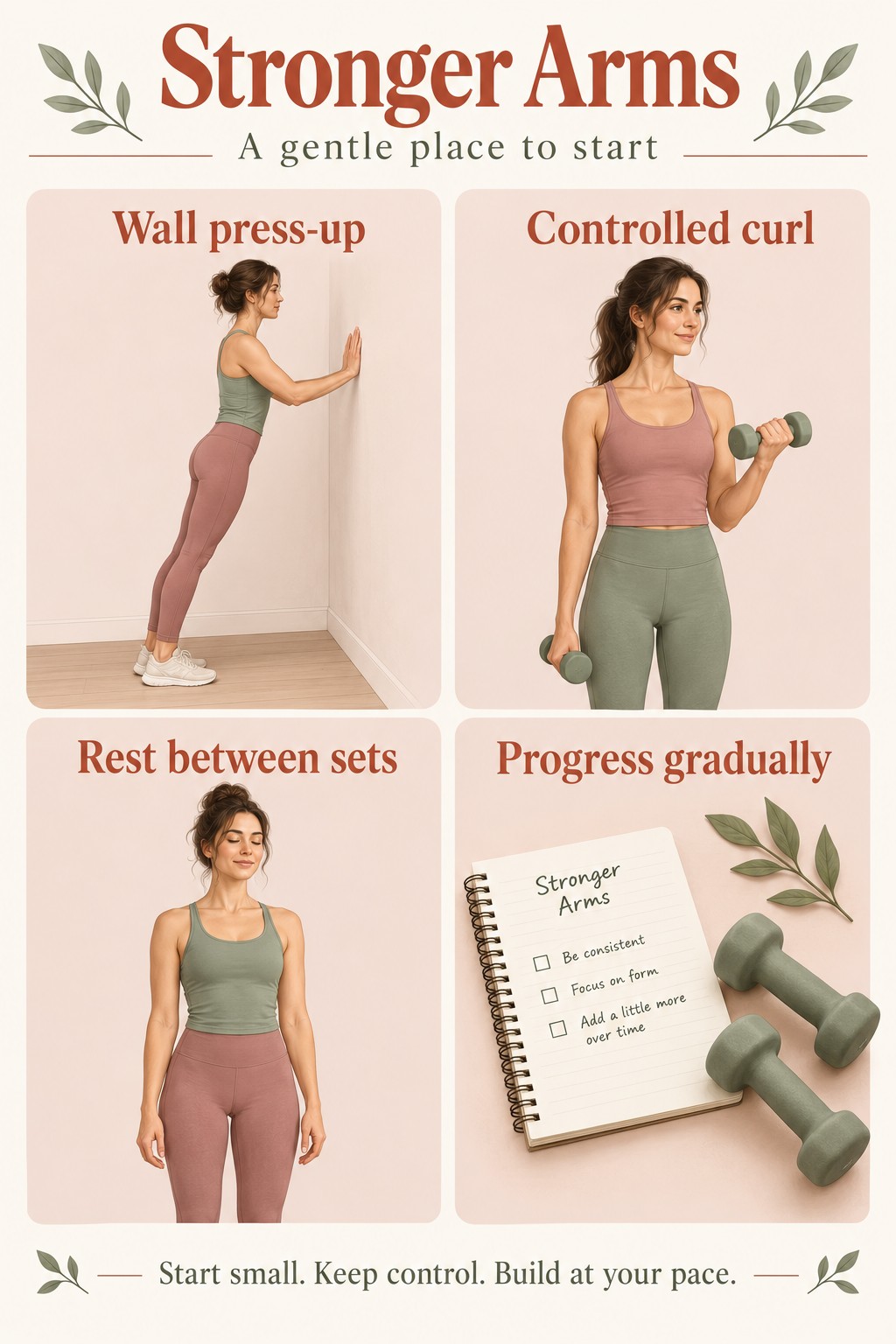
This is a useful way to practise a pushing movement without starting on the floor. Stand facing a wall with your hands at about chest height, a little wider than shoulder width. Keep your feet secure and your body in a comfortable, fairly straight line.
- Bend your elbows slowly and move your chest towards the wall.
- Keep your shoulders away from your ears and avoid letting the lower back sag.
- Press back to the starting position without snapping your elbows straight.
- Keep breathing throughout; stop the set before control disappears.
The NHS strength exercise guide includes wall press-ups and biceps curls with illustrated instructions. Begin close enough to the wall that the movement feels manageable.
Exercise two: controlled biceps curl
Stand comfortably, with your arms by your sides and palms facing forward. If standing feels unsteady, sit in a sturdy chair with your feet supported. Keep your elbows near your body as you bend them and bring the weights upwards. Lower the weights slowly rather than dropping your arms.
If you need to lean back, swing the bottles or lift your shoulders, the resistance may be too high. A lighter weight with a steady movement gives you a clearer starting point. Match the range and pace on both sides as comfortably as you can.
A simple first-session plan
- Warm up gently.
- Try one set of about five comfortable wall press-ups.
- Rest until your breathing and grip feel ready.
- Try one set of about five controlled curls.
- Finish with relaxed walking and note how the session felt.
This is an example starting session, not a test you must pass. Fewer repetitions are fine. If it feels easy and remains comfortable, gradually add repetitions over future sessions before increasing resistance. Change one thing at a time so you know what your body is responding to.
Make progress measurable
Record the exercise, the weight or wall position, the repetitions and a brief note about control. “Six smooth repetitions” is a more useful entry than “good workout.” Repeating the same setup lets you compare sessions fairly.
Plan rest days between demanding sessions for the same muscles. The NHS recommends strengthening all major muscle groups on at least two days a week. Pair this arm practice with suitable lower-body and whole-body activity as part of a broader plan. Our beginner leg workout offers complementary lower-body ideas.
Frequently asked questions
Will this remove upper-arm fat?
No exercise can guarantee fat loss from a chosen area. Use this routine to develop strength and confidence with movement. Appearance changes depend on many factors and are not a useful day-to-day score.
Do I need heavier weights every week?
No. First improve control and find a routine you can repeat. Increase the challenge gradually when your current version feels comfortable, rather than following a fixed timetable.
What if an exercise hurts?
Stop for sharp pain, dizziness or unusual breathlessness. Do not push through chest pain or severe breathing difficulty; seek urgent medical help. For repeated joint discomfort, get advice before trying the movement again.
Editorial update: 21 October 2026.