Fine Lines and Wrinkles: A Simple, Realistic Skin-Care Routine
Fine lines are part of normal skin ageing. If you want to soften their appearance, begin with a routine your skin can tolerate. A mask that promises to erase wrinkles in a week usually creates expectations that the product cannot meet.
Get the basics into a repeatable order
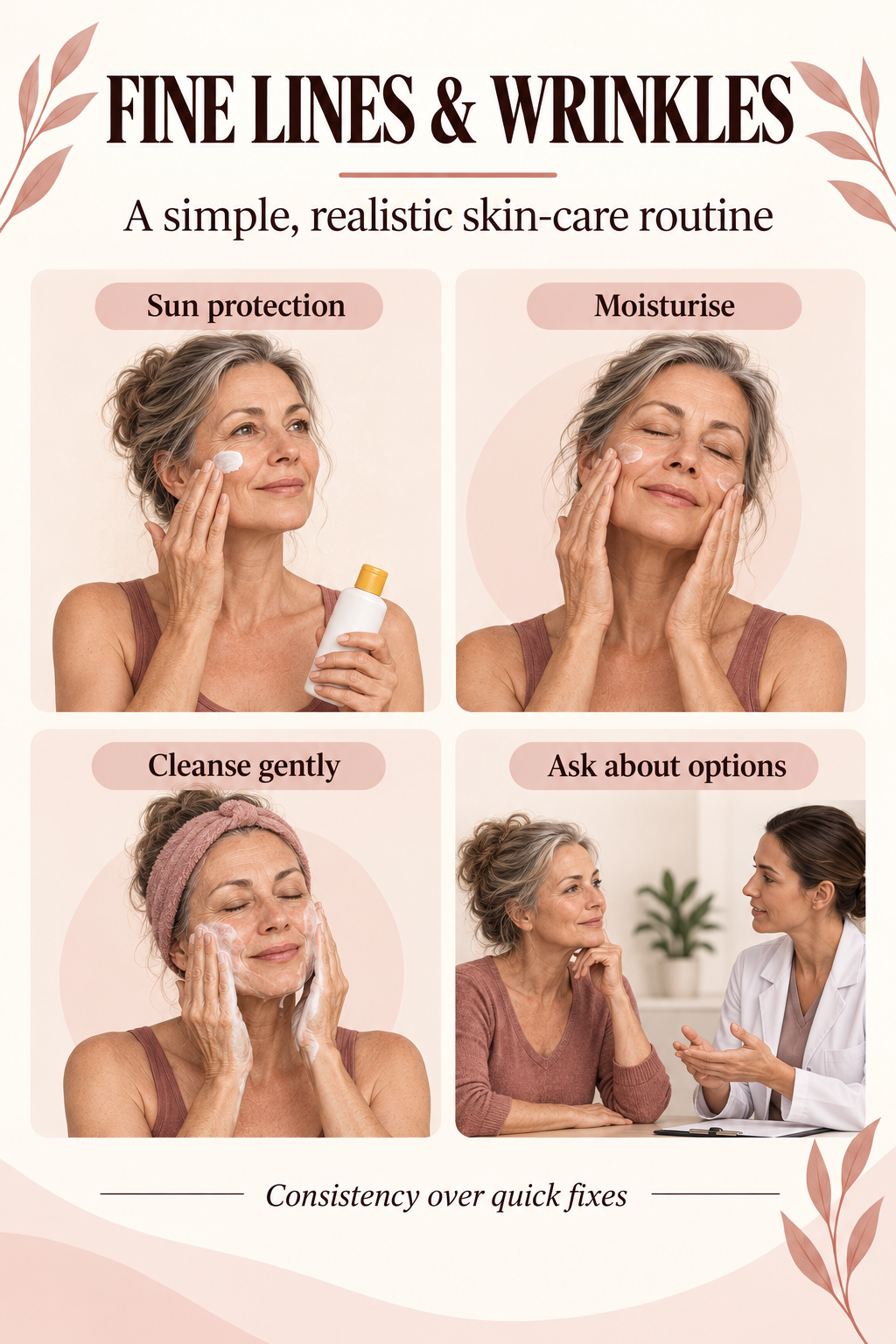
In the morning, cleanse gently if needed, moisturise and apply broad-spectrum SPF 30 or higher to exposed skin. At night, remove makeup and sunscreen, then moisturise again. Keep the products where you use them so the routine takes a few minutes rather than becoming another project.
Moisturiser can make fine lines look less noticeable by improving hydration; it does not lift sagging skin. The American Academy of Dermatology explains this distinction.
Add an active ingredient only if you want one
Retinol and other retinoids may help mild fine lines, but they can irritate sensitive skin. Follow the product directions and avoid starting several active products together. Do not use retinoids during pregnancy; discuss suitable alternatives with your clinician. See the AAD guide to retinol and retinoids for the differences and precautions.
Write down the date you introduce a product. If your skin becomes sore, simplify the routine rather than adding another treatment to counteract the first one. Repeated burning is not a useful progress measure.
Leave kitchen experiments out of the routine
Lemon juice, rough sugar scrubs and raw-egg masks are unnecessary. A long ingredient list is not evidence of effectiveness, and food does not automatically become a well-formulated skin product when blended.
Choose one goal—less dryness, a comfortable sunscreen or a simpler evening routine—and work on that first. If you want a larger change, a dermatologist can discuss procedures and realistic outcomes. For an everyday cosmetic approach, our guide to a natural-looking makeup finish can help without making normal texture something to hide.