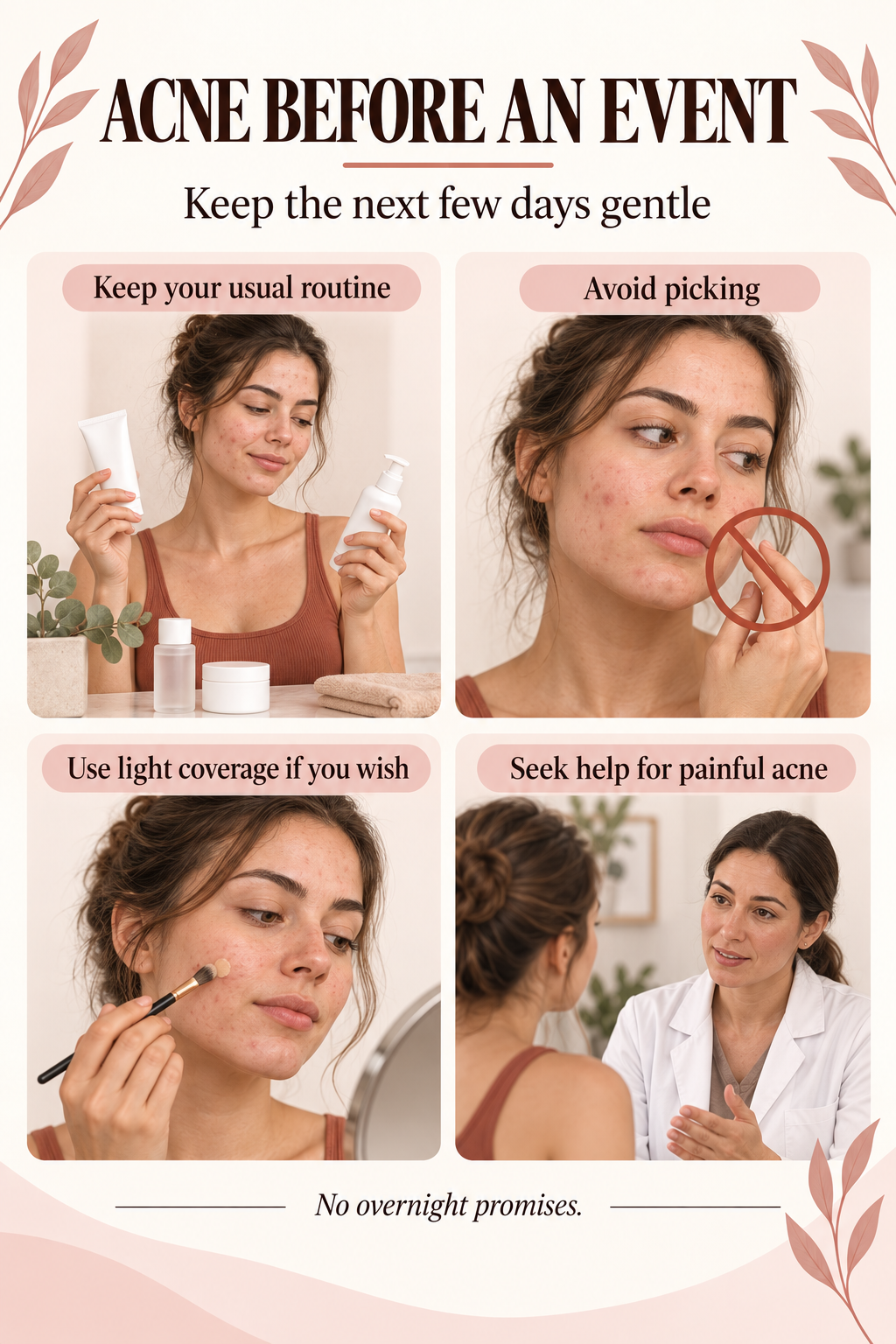
Acne Before an Event: What to Do Over the Next Three Days
A breakout before a wedding, interview or photograph can make every mirror feel unusually important. Three days is enough time to simplify your routine and avoid making an irritated spot worse, but it is not a reliable deadline for clearing acne.
Quick answer: Keep familiar care consistent, leave spots alone and avoid last-minute experiments. Deep or painful acne deserves professional advice; no home remedy can promise clear skin in three days.
Start with a realistic goal
Choose comfort and less interference as your immediate aims. A pimple may change during the next few days, but its timing is not under your complete control. Buying several new treatments can leave you dealing with peeling or redness as well as the original blemish. Your event does not require perfectly smooth skin.
Keep prescribed treatment on its agreed schedule unless your clinician advises otherwise. If you already tolerate an over-the-counter acne product, follow its label rather than adding extra applications. More product is not a shortcut. For a longer-term approach, see our guide to a gentler acne and oily-skin routine.
Day one: remove the experiments
Wash gently with a suitable cleanser, use your usual moisturiser and protect exposed skin from the sun. Put away abrasive scrubs, cleansing brushes and unfamiliar peels. Avoid toothpaste, lemon juice and rubbing alcohol on a spot: household products are not targeted acne care.
Leave a blemish unpicked, even if you can see a white centre. Repeated squeezing can increase irritation and the risk of lasting marks. Avoid checking it by touch throughout the day. Keep the routine easy enough that you can repeat it without thinking about the breakout every hour.
Day two: keep care steady
Repeat your familiar routine. If your skin feels sore, flaky or unusually tight after a new product, stop that experiment instead of covering the reaction with another active ingredient. Seek medical advice for a significant reaction. Give the skin some space from friction, heavy rubbing and constant product changes.
If makeup is part of your event plans, try a light application using products you already know. Clean tools and gentle removal matter more than finding the strongest possible coverage. Pat a small amount of concealer where you want it, then step back into ordinary daylight. A close-up magnifying mirror can encourage unnecessary layers.
Day three: make the morning simple
Allow time for your moisturiser to settle before makeup. Use thin layers and leave dry areas alone rather than buffing repeatedly. Take a small touch-up kit if it helps you feel prepared, but avoid repeatedly washing and rebuilding your makeup during the day.
Remove makeup gently afterwards and return to your normal care. Do not scrub to compensate for having worn coverage. A useful event plan includes the evening routine, when tiredness can make picking or harsh cleansing more tempting.
When a dermatologist can help
A deep, painful spot or recurring acne is a reason to ask for professional guidance. Tell the clinician about the event and any products or prescriptions you use. They can assess whether treatment is appropriate; availability and results vary, and an appointment is not a guarantee of overnight clearance.
The American Academy of Dermatology explains habits that can worsen acne, including frequent treatment changes and picking. If marks remain after a breakout, our guide to acne marks and scars explains why they need different expectations.
Frequently asked questions
Can acne disappear in three days?
Some individual spots settle quickly, but acne treatment usually needs a longer, consistent approach. No routine can guarantee complete clearance by a particular event.
Will toothpaste dry a pimple safely?
It is not an acne treatment and can irritate skin. Stick with products made for the skin and use them as directed.
Do I have to skip makeup?
Not necessarily. Choose products your skin tolerates, avoid sharing tools and remove makeup gently. Skip anything that stings or worsens irritation.
Editorial update: 21 October 2026.