How to Straighten Hair with Less Heat Damage
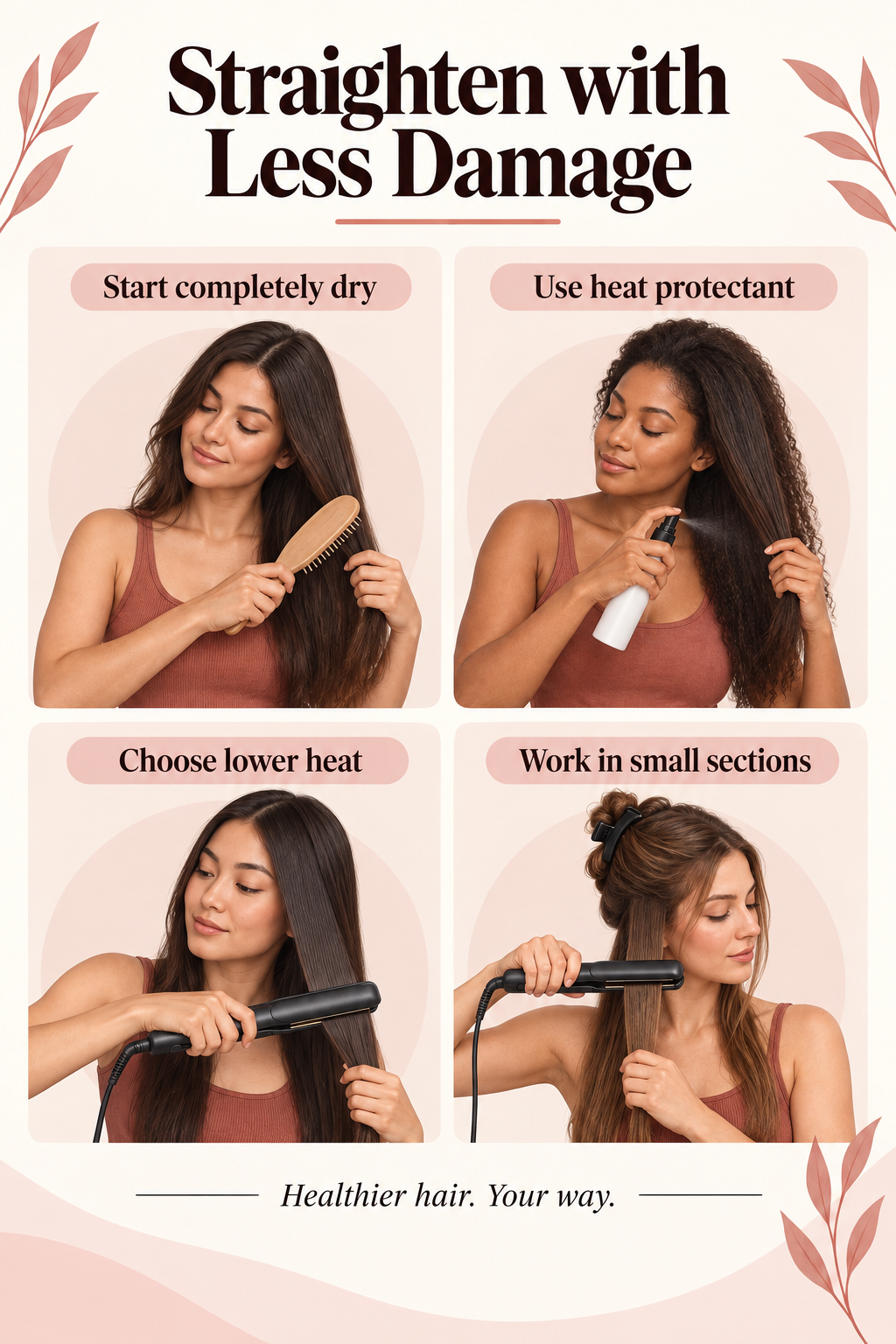
A sleek finish does not have to mean brittle, overworked hair. A way to reduce damage when straightening is to start with completely dry, detangled hair, use a heat protectant, and keep both the temperature and the number of passes as low as possible.
Before you reach for the straightener
Clean hair is easier to style, but it does not need to be freshly washed every time. The important part is that the hair is dry from roots to ends. Using a flat iron on damp hair increases the risk of damage.
Brush or comb gently first. If your hair tangles easily, begin at the ends and work upward. Apply heat protectant evenly, then wait until your hair is completely dry again before styling.
Choose the lowest effective temperature
Fine, fragile, bleached, or colour-treated hair generally needs less heat than thick, coarse hair. Start low; if a section will not smooth easily, reassess the preparation and section size rather than automatically turning up the heat. You do not need to chase an exact number; follow your tool and product instructions and pay attention to how your hair responds.
Work in small sections
Divide your hair into manageable sections. A section should be thin enough for the plates to touch the whole strand evenly. This lets you move smoothly through each piece once instead of repeatedly pressing the same area.
- Clamp near the roots without touching the scalp.
- Glide slowly but continuously to the ends.
- Do not pause in one spot.
- If a section still looks uneven, let it cool and reassess before making another pass.
What to avoid
Avoid straightening wet or damp hair, applying cooking oils before hot tools, or using the highest setting by default. Oils are not a substitute for a heat protectant, and heavy layers of product can make hair feel coated rather than smooth.
Help the style last
Once your hair has cooled, use a light finishing product only if you need it. Humidity can bring back texture, so a little anti-frizz serum on the ends may be helpful. On the days between heat styling, choose loose styles, detangle gently, and give your hair a break from hot tools where possible.
When to pause heat styling
If you notice snapping, roughness that does not improve with conditioner, or increasing split ends, reduce how often you use heat and consider a trim. A stylist can help you choose a cut and routine that works with your natural texture.
The takeaway: completely dry hair, heat protectant, small sections, and fewer passes make the biggest difference.
A quick check before switching on
- Read the tool instructions and choose an appropriate low setting.
- Check that your hair and any applied product are fully dry.
- Have clips ready so you can work through one small section at a time.
- Set the tool on a suitable heat-resistant surface away from water.
- Allow time to work calmly; rushing encourages repeated passes.
The AAD’s hair-care guidance recommends reducing heat-tool use and using lower settings. If you hear sizzling or notice a burning smell, stop. Do not interpret either as a normal sign that a difficult section is being smoothed.
Refresh without redoing the whole style
Before reaching for the iron the next day, decide whether the hair needs heat at all. A gentle detangle, a loose style or simply accepting some returning texture may be enough. Repeatedly pressing the same front pieces can add exposure even when you are not doing a full styling session.
For very fragile or recently chemically treated hair, ask a stylist about a routine that uses less heat. Bring the names of treatments you have used so the advice is specific. A smooth-looking finish is not proof that damaged hair has been repaired.
Common questions
Can I straighten hair while it is slightly damp?
For this flat-iron routine, wait until it is completely dry. That includes moisture left by styling products. Do not use hot plates as a shortcut for drying.
Does heat protectant prevent all damage?
No. It is one part of a lower-exposure routine, alongside fewer sessions, lower heat and fewer passes. Follow the product directions rather than adding unlimited layers.
Is chemical straightening the same process?
No. Chemical services have different products, risks and aftercare. Discuss them separately with a qualified stylist; this guide covers temporary styling with a flat iron.
Updated October 15, 2026. General information; individual health concerns need advice from a qualified professional.